Showing posts with label wonder. Show all posts

Thursday, January 26, 2012

Neither Snow nor Rain ...

I stumbled across this today.  Do you know this phrase?

"Neither snow nor rain nor heat nor gloom of night stays these couriers from the swift completion of their appointed rounds."
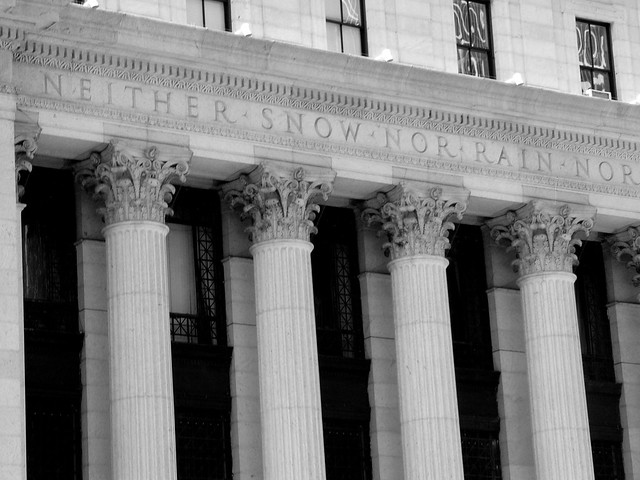
Of course we know this as the postal service creed. But, it's not. According to the USPS, they have no official creed. The reason this phrase has been associated with the postal service is because of an inscription on the collanade outside of the James Farley Post Office in New York City. The inscription was placed on the building by the firm of McKim, Mead & White, the architects who designed the Farley Building and the original Pennsylvania Station in the same Beaux-Arts style.

An interesting aside:
The original Pennsylvania Station stood directly opposite the James Farley Post Office building which was meant to match in strength the colonnade that originally faced it across 8th avenue.  The original Pennsylvania Station was unfortunately demolished in 1963, much to the horror of many who opposed its destruction. The New York Times editorially lamented: "Until the first blow fell, no one was convinced that Penn Station really would be demolished, or that New York would permit this monumental act of vandalism against one of the largest and finest landmarks of its age of Roman elegance." ["Farewell to Penn Station". The New York Times. October 30, 1963. (The editorial goes on to say that “we will probably be judged not by the monuments we build but by those we have destroyed”).]

"Neither snow nor rain ..." is actually a borrowed phrase from Herodotus' Histories (Book 8, Ch. 98) and describes the faithful service of the Persian system of mounted postal messengers under Xerxes I of Persia.  Wasn't that the Persian ruler who led the battle agaist the Spartans in the 300 movie??  The original phrase read:

"It is said that as many days as there are in the whole journey, so many are the men and horses that stand along the road, each horse and man at the interval of a day’s journey; and these are stayed neither by snow nor rain nor heat nor darkness from accomplishing their appointed course with all speed."

Portions of this post are borrowed from:

Sunday, January 22, 2012

Hadrian's Wall

What comes to mind when you think of Hadrian's Wall?  Personally, having only read of it in history books and only seen glimpses of it in movies, I have this vision of a massive, impenetrable structure - much like I have seen of the Great Wall in China. But that is not necessarily the case with Hadrian's Wall.


Hadrian's Wall was built by the Romans around 120 AD, during the rule of emperor Hadrian. It was a time when the Roman Empire had ceased to expand and there was a general concern of maintaining existing lands. Some say that the wall was built to protect Rome from the barbarians, but other sources suggest that the northern peoples that remained, in what is now Scotland, presented little threat to the empire. The wall instead may have been built as a political display of might. It's possible that the wall was even covered in plaster and white washed so that it gleamed in the sun and could be seen for miles around (Anthony Everitt (2009) Hadrian and the Triumph of Rome, Random House).

The most heavily fortified border in the whole of the empire, the wall was 80 Roman miles long (about 73 statute miles) and extended west from Segedunum at Wallsend on the River Tyne to the shore of the Solway Firth - clear across, what is now England. In places, the wall measured roughly 10 feet wide and 10-20 feet tall - depending on construction materials available - and was buffeted on either side by berms and ditches. Definitely not as formidable as the Great Wall in China. Construction also called for 80 small gated milecastle fortlets, one placed every Roman mile, holding a few dozen troops each, and pairs of evenly spaced intermediate turrets used for observation and signaling.

A significant portion of the wall still exists, particularly the mid-section, and for much of its length the wall can be followed on foot by Hadrian's Wall Path.

More information can be found on Wikipedia.

Wednesday, January 18, 2012

What Holds Clouds in Place?

I am curious. Why should clouds group together in the sky? Why do the edges of clouds always look like they are slowly evaporating away?  The edges of clouds always appear to be moving away from the main mass of cloud. How come we never see them moving in toward the cloud?  Perhaps clouds form due to surface tension, like how oil forms into globules when floating in water. But then why don't clouds have smooth rounded edges like oil globules?

Tuesday, January 3, 2012

Piping Hot

When I looked up the origin of the phrase "piping hot" tonight, I had no idea how old the phrase was. Interestingly, if you can believe it, we have been using this phrase in common English since the days of Chaucer in the 14th century. 

In 1390 in The Miller's Tale, Geoffrey Chaucer wrote:

He kembeth his lokkes brode, and made hym gay;
He woweth hire by meenes and brocage,
And swoor he wolde been hir owene page;
He syngeth, brokkynge as a nyghtyngale;
He sente hire pyment, meeth, and spiced ale,
And wafres, pipyng hoot out of the gleede;
And, for she was of town, he profred meede;″

Another source suggests (along the same lines):
"The derivation of this little phrase is the sizzling, whistling sound made by steam escaping from very hot food, which is similar to the sound of high-pitched musical pipes."

Interesting. I am not sure if this what Chaucer was getting at, but given the choice, I prefer mead too. 

Monday, December 12, 2011

THE Glenlivet

Ever notice that there is a "The" affixed to Glenlivet on the bottle?  Ever wonder why this is the case?

Did you know that The Glenlivet is the most sold single malt scotch in the US and the 2nd most sold single malt scotch in the world? In their advertising, The Glenlivet, claim to be the scotch that started it all. 

The Glenlivet is named after the geographic region of it's production - the Glenlivet Parish, near Moray, Scotland. It is the oldest legal distillery in that area, having been in continuous operation since 1824. It did close only briefly during WWII.

But why should it be named so?

Well, in 1871, when George Smith (the distillery's owner) died and left his very successful business to his son, John Gordon Smith, other distilleries in the area tried to profit from the name and Glenlivet's high quality product.  These other distillers started naming their distilleries Glenlivet as well.  John Gordon Smith attempted legal action claiming rights to the Glenlivet name. Unfortunately, they were only partially suscessful. Other distillers could still hyphenate the Glenlivet name (presumably because the name was also a geographic entity). 

So, the name of the Glenlivet distillery became The Glenlivet, emphasizing, I suppose, their originality. 

Source: for the most part Wikipedia

Sunday, December 11, 2011

How did the Head get it's name?

The toilet on a sailing vessel is called the head, but how did it get it's name?

What you may not know is unlike modern sailing vessels, the big sailing vessels of the past - because of the way they were rigged - could only sail with the wind. In other words, the wind must be behind them.

It was not until the invention of modern rigging that sailors could sail in almost any direction, except directly into the wind. In fact, out of 360 degrees, only 60-100 degrees of direction are not sailable in modern sailing vessels, as there would not be enough wind in the sails for forward progress to outweigh the pushback from the wind. This area of water directly into the wind (the red wedge shown below or A and B) is called the No Go Zone. Given this diagram, I would presume the only direction the older rigged sailing vessels could sail would be the 60-100 degrees in the D and E direction. 

 Points of sail for modern sailing vessels

So back to why the head is named the head. Well, as you can imagine the head of a sailing vessel could get pretty stinky. In their ultimate wisdom, ship designers put this area down-wind and as far away from other areas as they could, thus because of their direction of travel ... At the head of the ship.

The other benefit to this location was, because the head would empty directly to the sea, the chutes were regularly cleansed by sea-water that washed up into the openings while the ship was at sea.