Don't worry. Nothing bad happened. I just stumbled across this little tidbit on the Internet today and thought it worthy of sharing in the blog.
Have you ever wondered where the term vandalism comes from?
Around 439 AD, there was an East Germanic tribe called the Vandals, who under king Genseric formed a kingdom in North Africa, around the area that is now Tunisia. Part of this kingdom included an area that was claimed by Rome - the Roman Africa province. In 455, the Vandals sacked the city of Rome, leaving a great deal of destruction in their wake. The north Africa Vandal kingdom was only held for about 100 years at which point, in the Vandalic War (533-4), Justinian I re-siezed control for the Eastern Roman Empire.
Early Pro-Roman historians classified the Vandals, as, I suppose, any culture that was not Roman, barbarians for their sacking and looting of Rome. While the Vandals destruction of Roman antiquities was likely no more destructive than other invaders of the time, the Vandals were often blamed for Rome's downfall.
So, the Vandals got a bad rep and a bad rap. But it wasn't until much later (1794) that the term "vandalisme" was coined by Henri Grégoire to describe the destruction of artwork following the French Revolution. The term quickly swept into public use across Europe and - as we well know - is still used to this day to describe wanton or useless destruction of property.
Information gathered from Wikipedia (the fount of all knowledge)
Showing posts with label history. Show all posts
Friday, June 1, 2012
Thursday, January 26, 2012
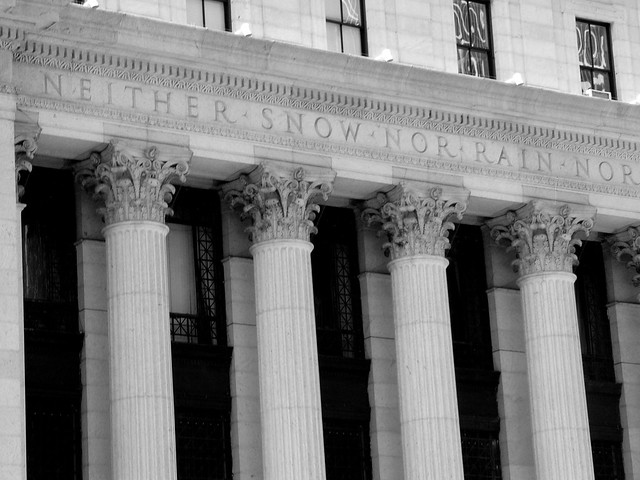
Neither Snow nor Rain ...
I stumbled across this today. Do you know this phrase?
"Neither snow nor rain nor heat nor gloom of night stays these couriers from the swift completion of their appointed rounds."
Of course we know this as the postal service creed. But, it's not. According to the USPS, they have no official creed. The reason this phrase has been associated with the postal service is because of an inscription on the collanade outside of the James Farley Post Office in New York City. The inscription was placed on the building by the firm of McKim, Mead & White, the architects who designed the Farley Building and the original Pennsylvania Station in the same Beaux-Arts style.
An interesting aside:
The original Pennsylvania Station stood directly opposite the James Farley Post Office building which was meant to match in strength the colonnade that originally faced it across 8th avenue. The original Pennsylvania Station was unfortunately demolished in 1963, much to the horror of many who opposed its destruction. The New York Times editorially lamented: "Until the first blow fell, no one was convinced that Penn Station really would be demolished, or that New York would permit this monumental act of vandalism against one of the largest and finest landmarks of its age of Roman elegance." ["Farewell to Penn Station". The New York Times. October 30, 1963. (The editorial goes on to say that “we will probably be judged not by the monuments we build but by those we have destroyed”).]
"Neither snow nor rain ..." is actually a borrowed phrase from Herodotus' Histories (Book 8, Ch. 98) and describes the faithful service of the Persian system of mounted postal messengers under Xerxes I of Persia. Wasn't that the Persian ruler who led the battle agaist the Spartans in the 300 movie?? The original phrase read:
"It is said that as many days as there are in the whole journey, so many are the men and horses that stand along the road, each horse and man at the interval of a day’s journey; and these are stayed neither by snow nor rain nor heat nor darkness from accomplishing their appointed course with all speed."
Portions of this post are borrowed from:
"Neither snow nor rain nor heat nor gloom of night stays these couriers from the swift completion of their appointed rounds."
Of course we know this as the postal service creed. But, it's not. According to the USPS, they have no official creed. The reason this phrase has been associated with the postal service is because of an inscription on the collanade outside of the James Farley Post Office in New York City. The inscription was placed on the building by the firm of McKim, Mead & White, the architects who designed the Farley Building and the original Pennsylvania Station in the same Beaux-Arts style.
An interesting aside:
The original Pennsylvania Station stood directly opposite the James Farley Post Office building which was meant to match in strength the colonnade that originally faced it across 8th avenue. The original Pennsylvania Station was unfortunately demolished in 1963, much to the horror of many who opposed its destruction. The New York Times editorially lamented: "Until the first blow fell, no one was convinced that Penn Station really would be demolished, or that New York would permit this monumental act of vandalism against one of the largest and finest landmarks of its age of Roman elegance." ["Farewell to Penn Station". The New York Times. October 30, 1963. (The editorial goes on to say that “we will probably be judged not by the monuments we build but by those we have destroyed”).]
"Neither snow nor rain ..." is actually a borrowed phrase from Herodotus' Histories (Book 8, Ch. 98) and describes the faithful service of the Persian system of mounted postal messengers under Xerxes I of Persia. Wasn't that the Persian ruler who led the battle agaist the Spartans in the 300 movie?? The original phrase read:
"It is said that as many days as there are in the whole journey, so many are the men and horses that stand along the road, each horse and man at the interval of a day’s journey; and these are stayed neither by snow nor rain nor heat nor darkness from accomplishing their appointed course with all speed."
Portions of this post are borrowed from:
Sunday, January 22, 2012
Hadrian's Wall
What comes to mind when you think of Hadrian's Wall? Personally, having only read of it in history books and only seen glimpses of it in movies, I have this vision of a massive, impenetrable structure - much like I have seen of the Great Wall in China. But that is not necessarily the case with Hadrian's Wall.

Hadrian's Wall was built by the Romans around 120 AD, during the rule of emperor Hadrian. It was a time when the Roman Empire had ceased to expand and there was a general concern of maintaining existing lands. Some say that the wall was built to protect Rome from the barbarians, but other sources suggest that the northern peoples that remained, in what is now Scotland, presented little threat to the empire. The wall instead may have been built as a political display of might. It's possible that the wall was even covered in plaster and white washed so that it gleamed in the sun and could be seen for miles around (Anthony Everitt (2009) Hadrian and the Triumph of Rome, Random House).
The most heavily fortified border in the whole of the empire, the wall was 80 Roman miles long (about 73 statute miles) and extended west from Segedunum at Wallsend on the River Tyne to the shore of the Solway Firth - clear across, what is now England. In places, the wall measured roughly 10 feet wide and 10-20 feet tall - depending on construction materials available - and was buffeted on either side by berms and ditches. Definitely not as formidable as the Great Wall in China. Construction also called for 80 small gated milecastle fortlets, one placed every Roman mile, holding a few dozen troops each, and pairs of evenly spaced intermediate turrets used for observation and signaling.
A significant portion of the wall still exists, particularly the mid-section, and for much of its length the wall can be followed on foot by Hadrian's Wall Path.
More information can be found on Wikipedia.
Hadrian's Wall was built by the Romans around 120 AD, during the rule of emperor Hadrian. It was a time when the Roman Empire had ceased to expand and there was a general concern of maintaining existing lands. Some say that the wall was built to protect Rome from the barbarians, but other sources suggest that the northern peoples that remained, in what is now Scotland, presented little threat to the empire. The wall instead may have been built as a political display of might. It's possible that the wall was even covered in plaster and white washed so that it gleamed in the sun and could be seen for miles around (Anthony Everitt (2009) Hadrian and the Triumph of Rome, Random House).
The most heavily fortified border in the whole of the empire, the wall was 80 Roman miles long (about 73 statute miles) and extended west from Segedunum at Wallsend on the River Tyne to the shore of the Solway Firth - clear across, what is now England. In places, the wall measured roughly 10 feet wide and 10-20 feet tall - depending on construction materials available - and was buffeted on either side by berms and ditches. Definitely not as formidable as the Great Wall in China. Construction also called for 80 small gated milecastle fortlets, one placed every Roman mile, holding a few dozen troops each, and pairs of evenly spaced intermediate turrets used for observation and signaling.
A significant portion of the wall still exists, particularly the mid-section, and for much of its length the wall can be followed on foot by Hadrian's Wall Path.
More information can be found on Wikipedia.
Thursday, August 4, 2011
What Did Van Learn Today?
I learned that in June of 1942, there was, what we would now call a terrorist attack, in Washington DC, orchestrated by the Nazi party.
Operation Pastorius was a failed plan for sabotage via a series of attacks by Nazi German agents inside the United States. The operation was named by Admiral Wilhelm Canaris, chief of the German Abwehr, for Francis Daniel Pastorius, the leader of the first organized settlement of Germans in America.
The plan was fairly complex as it involved sabotage on major industrial and economic targets throughout the US, including hydroelectric plants at Niagara Falls and aluminum plants in Illinois, Tennessee and New York. Two German-American citizens were involved, as well as 6 others who would arrive on shore via two different U-boats.
While there were many failures in the plot, the scheme was ultimately foiled by a would-be defector (George John Dasch), who turned himself in and revealed the whole plan to the authorities.
This operation was ultimately unsuccessful and those involved were executed, or in the case of the two conspirators who cooperated with the authorities, returned to Germany six years later in 1948.
You can read more about this on Wikipedia.
So ... How did I come to be reading about this tidbit of history?
Well, I was looking up the definition of "potter's field". Wikipedia listed the location of where the six executed conspirators were buried as a potter's field. Basically, a potter's field is where deceased persons of a certain class or economic situation, warranting segregation from the general populous, might be interred.
As it turns out, the location where the six conspirators were buried was in Blue Plains, near Ferry Point, on the Anacostia River, in what is now Oxon Hill Farm (an interactive farm - mostly for kids - managed by the National Park Service. One source, dated July 2008, mentions that there is a marker at the burial site (erected by the American Nazi Party), but that it is very difficult to find. That is something I would like to try to find.
Try to learn something new every day.
- Posted using BlogPress from my iPad
Operation Pastorius was a failed plan for sabotage via a series of attacks by Nazi German agents inside the United States. The operation was named by Admiral Wilhelm Canaris, chief of the German Abwehr, for Francis Daniel Pastorius, the leader of the first organized settlement of Germans in America.
The plan was fairly complex as it involved sabotage on major industrial and economic targets throughout the US, including hydroelectric plants at Niagara Falls and aluminum plants in Illinois, Tennessee and New York. Two German-American citizens were involved, as well as 6 others who would arrive on shore via two different U-boats.
While there were many failures in the plot, the scheme was ultimately foiled by a would-be defector (George John Dasch), who turned himself in and revealed the whole plan to the authorities.
This operation was ultimately unsuccessful and those involved were executed, or in the case of the two conspirators who cooperated with the authorities, returned to Germany six years later in 1948.You can read more about this on Wikipedia.
So ... How did I come to be reading about this tidbit of history?
Well, I was looking up the definition of "potter's field". Wikipedia listed the location of where the six executed conspirators were buried as a potter's field. Basically, a potter's field is where deceased persons of a certain class or economic situation, warranting segregation from the general populous, might be interred.
As it turns out, the location where the six conspirators were buried was in Blue Plains, near Ferry Point, on the Anacostia River, in what is now Oxon Hill Farm (an interactive farm - mostly for kids - managed by the National Park Service. One source, dated July 2008, mentions that there is a marker at the burial site (erected by the American Nazi Party), but that it is very difficult to find. That is something I would like to try to find.
Try to learn something new every day.
- Posted using BlogPress from my iPad
Friday, July 29, 2011
For American Distillers, a Whi... (theatlantic.com)
For American Distillers, a Whiskey Crisis Looms on the Horizon
http://www.theatlantic.com/life/archive/2011/07/for-american-distillers-a-whiskey-crisis-looms-on-the-horizon/242699/
---
Sent from Zite personalized magazine iPad app.
Available for free in the App Store.
www.zite.com
Sent from my iPad
Thursday, June 30, 2011
Key Bridge - Baltimore - An interesting little bit of history.
Looking north from our cruise ship as we passed under the Key Bridge. The key bridge carries the beltway (I-695) across the Patapsco River to complete the circuitous route around the city of Baltimore, Maryland. The bridge was opened in March 1977 and is named for the author of the Star Spangled Banner, Francis Scott Key. History scholars believe the span crosses within 100 yards (91 m) of the site, marked in the water off the bridge by a stars and striped painted buoy, where Francis Scott Key witnessed the bombardment of Fort McHenry on the evening of September 12, 1814.
The span is 1,200 feet (366 m) long and carries an estimated 11.5 million vehicles annually. It is a long span steel truss bridge with a suspended deck. The structure combines the behaviors of an arch, truss and cantilever. With no expansion joints, this bridge (at the time of this writing) is the second longest continuous steel truss bridge in the United States and the third longest in the world.
More information about this bridge can be found on Wikipedia and An Engineer's Guide to Baltimore.
The span is 1,200 feet (366 m) long and carries an estimated 11.5 million vehicles annually. It is a long span steel truss bridge with a suspended deck. The structure combines the behaviors of an arch, truss and cantilever. With no expansion joints, this bridge (at the time of this writing) is the second longest continuous steel truss bridge in the United States and the third longest in the world.
More information about this bridge can be found on Wikipedia and An Engineer's Guide to Baltimore.
Thursday, September 2, 2010
Eat Mo' Moonpies
You know the trouble with signs like this out in the midwest on some old highway? The sign entices you in - 'cause who doesn't like a nice moonpie now and then - but the store is completely gone. All that's left is an old parking lot with a lot of old rusted out cars and some antique signs ... much like the moonpie sign.
Pam and I spotted this sign while sitting in line at a construction site along New Mexico State Route 68, south of Taos, New Mexico.
No moon pies were had. Just disappointment.
Pam and I spotted this sign while sitting in line at a construction site along New Mexico State Route 68, south of Taos, New Mexico.
No moon pies were had. Just disappointment.
Subscribe to:
Posts (Atom)